Introduction
Every industrial operation that relies on pressure vessels understands, at least intuitively, that these assets carry serious risk. Boilers, heat exchangers, reactors, and storage vessels operating under elevated pressure are among the most failure-sensitive pieces of equipment in any facility. When they are designed correctly, certified by qualified professionals, and maintained in accordance with Australian regulatory requirements, they deliver decades of reliable service. When they are not, the consequences range from costly forced shutdowns to catastrophic failures that endanger people, damage surrounding infrastructure, and expose businesses to significant legal liability. The decision to pursue formal Pressure Vessel Certification Australia compliance is therefore not a discretionary one. It is a legal, ethical, and commercial obligation that every plant operator in Australia must take seriously.
What many businesses underestimate, however, is how significantly the quality of their engineering partner affects the outcome of that certification process. CSA Engineering has worked across Australia’s most demanding industrial sectors and has seen firsthand how the right engineering partnership transforms certification from a compliance burden into a strategic business advantage. This article explains what to look for, what questions to ask, and what separates a genuinely capable engineering partner from one that simply ticks boxes.
Why Pressure Vessel Certification Is Critical for Australian Businesses
Australian work health and safety legislation, plant and equipment regulations, and the AS 1210 and AS 4343 pressure vessel standards collectively create a comprehensive compliance framework that applies to virtually every industrial facility in the country. Meeting this framework requires more than buying the right equipment. It requires formal verification by qualified professionals that the equipment was designed to applicable standards, fabricated correctly, installed appropriately, and inspected at required intervals. Formal Engineering Certification provides that verification and creates the documented engineering record that regulatory bodies, insurers, and major clients expect to see.
Businesses that operate without current pressure vessel certification in Australia face a range of serious consequences including regulatory penalties, forced operational shutdowns, voided insurance coverage, and exclusion from major project prequalification processes. The certification process protects the business as much as it protects the people who work in and around the facility.
Understanding Pressure Vessel Certification Australia Requirements
The certification requirements for pressure vessels in Australia are detailed and jurisdiction-specific. At the national level, the Work Health and Safety Regulations require that pressure vessels above defined thresholds be registered with the relevant state authority before they enter service. Each state and territory then applies its own inspection frequency requirements, engineering sign-off obligations, and administrative processes. Navigating this regulatory landscape requires an Engineering Consultant who understands not only the technical engineering standards but also the procedural requirements that apply in your specific operating jurisdiction.
Certification requirements typically cover the following areas:
- Design verification confirming compliance with AS 1210 for pressure vessels or AS 1228 for boilers
- Fabrication inspection at critical stages during the manufacturing process
- Hydrostatic or pneumatic testing at defined pressure multiples of the design pressure
- In-service inspection at intervals defined by the relevant state authority
- Fitness-for-service assessment when defects, corrosion, or damage is identified
- Engineering sign-off by a registered professional engineer with appropriate jurisdiction-specific credentials
Understanding which of these requirements apply to your specific equipment, in your specific state, under your specific operating conditions, is precisely the kind of knowledge that a genuinely capable engineering partner brings to the relationship from day one.
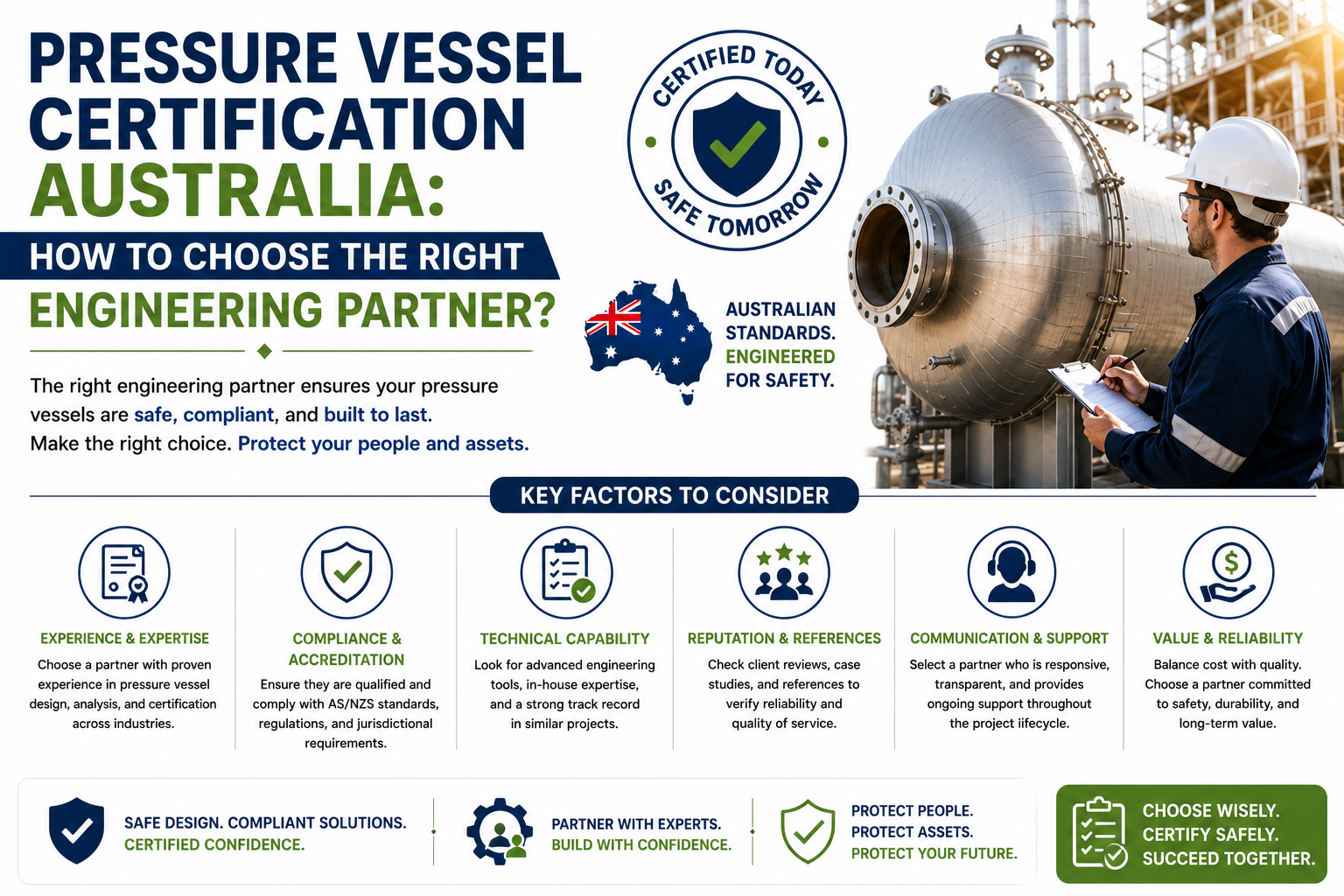
Key Factors to Consider When Choosing an Engineering Partner
Selecting an engineering partner for pressure vessel certification is a decision that deserves careful evaluation. The following factors are the most important to assess before committing to any firm.
- Verified qualifications and professional registration appropriate to the jurisdiction and equipment type
- Demonstrated project history with similar pressure vessel types and operating environments
- Capacity to support the full certification lifecycle from design review through to in-service inspection
- Clear and transparent processes for managing certification documentation and regulatory submissions
- Professional indemnity insurance coverage adequate to the value and risk profile of the project
- Responsive communication and realistic turnaround commitments that align with your operational schedule
The best engineering partners approach these criteria not as hurdles to clear but as the natural expression of how they operate. Experienced Engineering Consulting Services providers will answer questions about qualifications, references, and processes with specific, verifiable information rather than general assurances.
The Role of Pressure Vessel Design Services in Achieving Long Term Compliance
Certification is most effective when it begins at the design stage rather than being applied after the fact. Pressure vessels that are designed with certification requirements in mind from the outset are significantly easier and more economical to certify, recertify, and maintain over their full service life. This is the core value proposition of specialist Pressure Vessel Design Services that integrate compliance into the design process rather than treating it as a downstream administrative task.
Key elements of a compliance-integrated design process include:
- Material selection that accounts for the specific fluid chemistry, temperature range, and operating pressure
- Corrosion allowance engineering that reflects realistic degradation rates for the operating environment
- Access provision design that enables practical future inspection and maintenance activities
- Design documentation structured to support future certification submissions without significant rework
Why Experienced Pressure Vessel Design Consultants Matter
Not every pressure vessel application is standard. Chemical reactors operating with aggressive fluid chemistry, vessels subject to cyclic loading from repeated pressurisation and depressurisation, and equipment installed in remote or environmentally extreme locations all present engineering challenges that require specialist knowledge. Experienced Pressure Vessel Design Consultants bring the combination of materials expertise, structural analysis capability, and regulatory knowledge needed to address these challenges without compromising on safety margins or certification outcomes.
The most capable consultants also understand how regulatory bodies interpret complex design scenarios. This practical knowledge of how certification submissions are assessed allows them to structure documentation in a way that minimises queries, reduces revision cycles, and accelerates the approval timeline for their clients.
The Role of a Mechanical Engineering Consultant in Pressure Vessel Projects
Pressure vessel projects involve a range of engineering disciplines beyond structural analysis alone. Piping systems, support structures, nozzle reinforcements, lifting attachments, and insulation systems all require engineering input that goes beyond the vessel shell itself. A qualified Mechanical Engineering Consultant brings the discipline-specific expertise needed to address these connected systems in a way that is both technically correct and consistent with the overall certification approach. Engaging mechanical engineering expertise as part of a single integrated team, rather than managing multiple specialist subcontractors, significantly reduces the risk of coordination failures that can compromise certification outcomes.
Why Choosing an RPEQ Engineer Is Essential for Queensland Projects
In Queensland, the engineering sign-off requirement for pressure vessel certification carries specific legislative weight. The Professional Engineers Act 2002 requires that engineering services for regulated plant and equipment be provided by a Registered Professional Engineer of Queensland. Engaging a licensed RPEQ Engineer for your Queensland pressure vessel project is not optional. It is a legal requirement without which the certification documentation will not be accepted by Queensland’s work health and safety regulator, regardless of the technical quality of the engineering work itself.
CSA Engineering employs RPEQ-registered professionals with direct experience in pressure vessel certification across Queensland. The firm’s Queensland office, located at Stapylton, serves clients across the state with certification services that satisfy both the technical and legislative requirements of Queensland’s regulatory framework. The contribution of experienced RPEQ Engineers Australia to national project compliance cannot be overstated. Their registration provides a layer of legal accountability and professional credibility that underpins every certification outcome.
How Professional Engineer Certification Ensures Quality and Reliability
The formal credential of Professional Engineer Certification is the mechanism through which Australian engineering sign-offs carry legal weight. A certificate signed by a registered professional engineer is not simply a document. It is a statement of professional accountability, backed by the engineer’s registration, their professional indemnity insurance, and their obligation to uphold the ethical standards of the profession. This accountability is what makes the certification credible to regulators, insurers, legal advisors, and future owners of the asset.
When evaluating potential engineering partners, always confirm that the professionals who will sign your certification documentation hold current registration appropriate to the jurisdiction and scope of the work. This single verification step protects your business from the very real risk of holding certification documentation that lacks legal standing.
Why Businesses Across Australia Trust CSA Engineering
CSA Engineering has built its reputation on delivering pressure vessel certification outcomes that satisfy regulators, withstand scrutiny, and support the long-term operational performance of the assets they cover. The firm combines formal engineering qualifications across structural, mechanical, and industrial disciplines with RPEQ registration for Queensland projects and credentials recognised under state and national Australian legislation.
Clients who choose CSA Engineering as their engineering partner benefit from:
- End-to-end pressure vessel certification support from initial design review through to final engineering certificate
- RPEQ-registered sign-off for Queensland projects and appropriately registered professionals across all other Australian states
- Mechanical and industrial engineering expertise covering the full range of connected systems and equipment
- Certification documentation accepted by Australian state regulators, building certifiers, and insurers
- Ongoing compliance support covering in-service inspections, recertification, and fitness-for-service assessment
Discover the full scope of CSA Engineering’s capabilities and speak directly with a qualified engineer about your project by visiting https://www.csaengineering.com.au/.
Conclusion
The right engineering partner for pressure vessel certification in Australia is one who brings verified qualifications, demonstrated industry experience, integrated technical capability across all relevant engineering disciplines, and a genuine commitment to delivering outcomes that protect their clients’ people, assets, and businesses. Pressure Vessel Certification Australia compliance is too important to entrust to a provider who treats it as a box-ticking exercise.
CSA Engineering invites plant operators, manufacturers, mining companies, and industrial facilities across Australia to connect with our team and experience what genuinely capable engineering partnership looks like in practice.