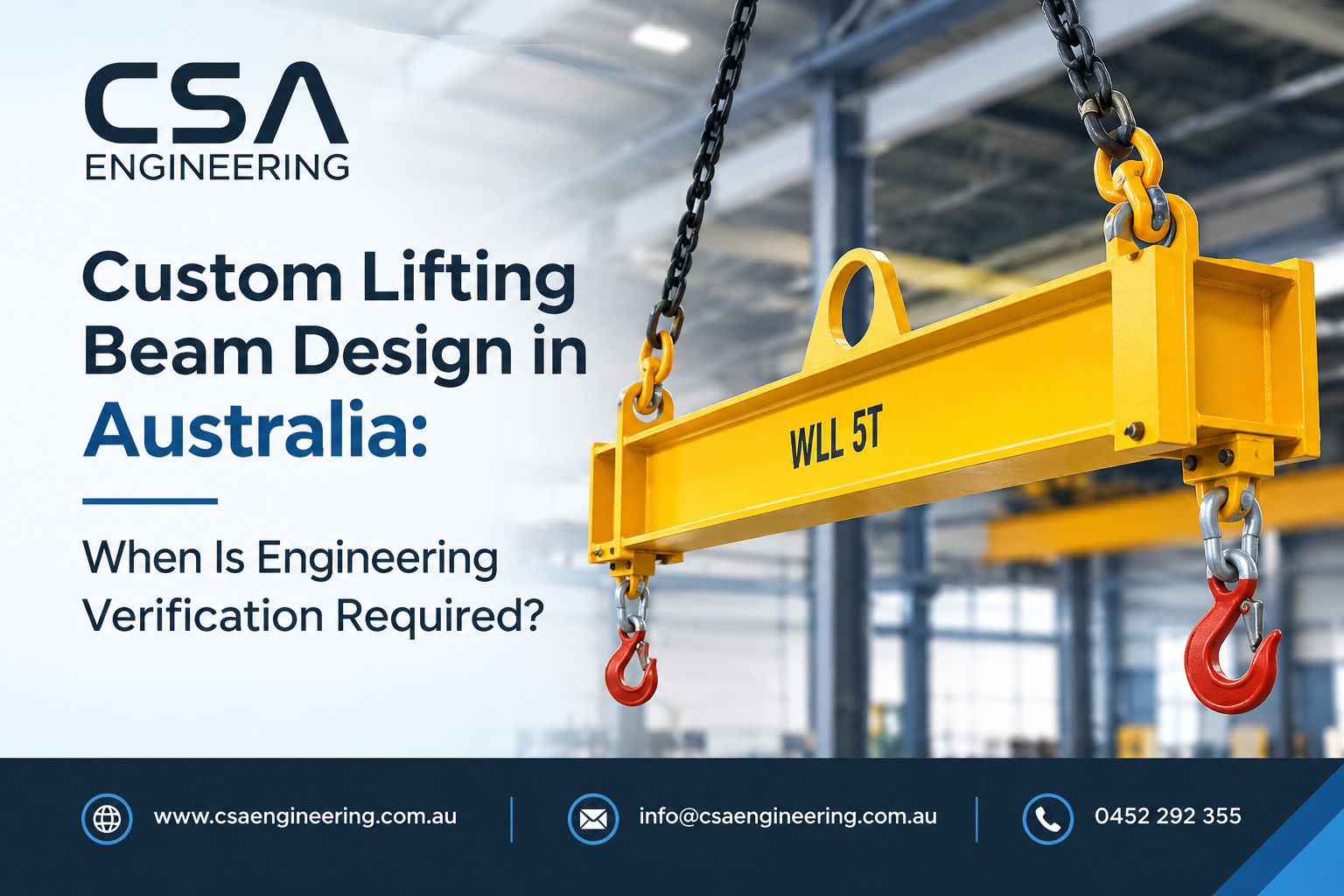
Custom lifting beam design looks simple on paper. It is a steel section, a few lifting points and a rated capacity on a plate. On site, though, it is a common reason for a lift to stall, because the beam arrives without the engineering records to prove it is safe.
Custom lifting beam design in Australia falls under AS 4991, so knowing when verification is required saves rework, delays and real safety risk. This guide explains which situations trigger engineering verification, what the standard allows, and which documents you should hold before the first lift.
What Sets Custom Lifting Beam Design Apart from Standard Beams
A catalogue beam is designed once, type tested and sold with a fixed set of configurations. A custom beam is built around your load, hook height, headroom and site. The span, lug positions, sling angles and attachments are all specific to the job.
That is why custom lifting beam design carries more engineering responsibility. Nobody has proven the geometry before. Load share, centre of gravity and rigging arrangement all need checking by a competent engineer.
In Australia, lifting beams are covered by AS 4991, the standard for lifting devices that attach to a crane or hoist hook. The standard is not legislation by itself. However, regulators, principal contractors and mine site owners treat it as the benchmark for below-the-hook devices. Under the model WHS laws, designers and manufacturers of plant must also ensure it is safe so far as reasonably practicable. Victoria has its own OHS legislation with similar expectations.
When Is Engineering Verification Required for Custom Lifting Beam Design?
Engineering verification is required whenever a lifting beam is purpose-built, modified, repaired, or has no traceable design records, and when it will be used outside its original rated configuration. Verification confirms the design, working load limit and testing meet AS 4991 before the beam is put into service.
Four situations trigger this requirement most often.
Purpose-built or one-off beams
If a beam is designed for a specific lift or plant item, verification is essential. There is no manufacturer type test to rely on. The calculations, drawings and test certificate are the only evidence of safety. This applies to the typical custom lifting beam design for transformer lifts, tank modules, precast panels and mining components.
Modified or repaired beams
Adding a lug, cutting a section, extending the span or welding a repair changes how the beam carries load. Even small changes can shift stress paths and weld fatigue behaviour. The original certificate no longer covers the altered beam, so it needs re-verification before reuse.
Beams with no design records
Older, imported and workshop-made beams often have no calculations, material certificates or test records. A proof load alone does not fix this. The beam usually needs reverse engineering to confirm materials, weld details and capacity before it can be certified.
Non-standard loads, geometry or duty
Off-centre loads, adjustable spans, multiple rigging configurations, frequent heavy use, harsh environments and lifts near the rated limit all raise the risk. These are signs the beam needs more than a catalogue rating.
When a Standard Beam May Not Need New Engineering
Not every beam needs fresh design work. A manufactured beam supplied with a current certificate, design documentation and clear marking can be used within its rated configurations without new verification.
You still need to confirm that the actual lift matches the certificate. A different sling angle, load position or attachment can take you outside its scope. If you are unsure, have an engineer review the lift before it goes ahead. Certification is also not the end of the story, because inspection, marking and records must be maintained while the beam stays in service.
Two Verification Routes Under AS 4991
Section 12 of AS 4991 allows two ways to verify a lifting device. Our guide to proof load testing and engineering analysis covers both in more depth.
Proof load testing. The beam is loaded above its working load limit and then examined. For devices up to 10 tonne WLL, the proof load is twice the WLL. Between 10 and 160 tonne, it follows 1.04 times the WLL plus 9.6 tonne. Non-destructive examination then checks welds and critical areas for defects. This suits standard, repeatable designs.
Engineering analysis. A competent engineer independently checks the design calculations, material and weld details, and sets out the testing the beam needs. This is usually the practical route for custom lifting beam design, because each beam is unique and the design must be justified before fabrication. Reduced proof tests or other testing may still apply.
Which route fits depends on whether the beam is a one-off, a batch product or an existing device with missing records. For the full sequence from documents to sign-off, see the lifting device certification process in Australia.
What a Verification Package for Custom Lifting Beam Design Should Include
A complete package typically contains:
- Design calculations for bending, shear, buckling, deflection, lugs, pins and welds
- Fabrication drawings showing materials, weld details and tolerances
- The duty classification and design load factors under AS 1418.1
- A fatigue check based on the expected number of lifting cycles
- A proof load certificate and NDT report where required
- Marking details such as WLL, serial number, manufacturer and year
- Instructions for use that set out approved rigging arrangements and limits
- A certificate of compliance from the verifying engineer
Keep these in your lifting device register. A client, auditor or insurer may ask for them years after the beam was built. Fabricated supports and connections may also need structural engineering input where the beam interfaces with a frame or structure.
Common Mistakes in Custom Lifting Beam Design
- Treating a test lift as certification. A beam can survive a load test and still have poor weld details or a lug that fails by tear-out under repeated use.
- Ignoring the load interface. The connection between the beam and the item being lifted often governs the design, so check it early.
- Overlooking headroom and sling angles. A beam that works structurally can still be unusable if the rigging consumes the available hook height.
- Leaving rigging limits undocumented. If instructions are unclear, crews may use the beam in configurations nobody verified.
- Engaging an engineer after fabrication. Problems found after the steel is cut mean rework. Good custom lifting beam design starts verification at concept stage.
How to Decide: A Checklist for Custom Lifting Beam Design
Ask these questions before the beam is used:
- Is it purpose-built or a one-off?
- Has it been modified, extended or repaired?
- Are the calculations, material records or test certificates missing?
- Will it be used outside its certified configurations?
- Does the site, client or principal contractor require documented compliance?
If any answer is yes, get engineering verification before the first lift. CSA Engineering’s industrial design and certification services cover design, verification and sign-off for lifting equipment, and the lifting devices certification team can assess existing or new beams.
Conclusion
Custom lifting beam design is not only about choosing a section that survives the lift. It is about proving the design, the testing and the records, so every crew that uses the beam can trust its rating. Verification is required for purpose-built, modified, undocumented or non-standard beams, and it is far cheaper before fabrication than after a failed audit or an incident.
If you are planning custom lifting beam design or need to certify an existing beam, get a free consultation with CSA Engineering.
FAQs
Does every custom lifting beam design need engineering verification?
Yes, in practice. A purpose-built beam has no type test behind it, so the design must be verified under AS 4991 before use.
What standard applies to lifting beams in Australia?
AS 4991 covers lifting devices fitted to a crane or hoist hook. It is used together with AS 1418.1 for duty classification and design loads.
Can a load test alone certify a lifting beam?
No. A proof load is one part of verification. Material, weld and design evidence, plus NDT, are also needed.
Can I modify a certified lifting beam?
You can, but the changes void the original certificate. The modified beam must be re-verified before it returns to service.
What documents should come with a custom lifting beam design?
Calculations, drawings, test and NDT records, marking details, instructions for use and a compliance certificate.