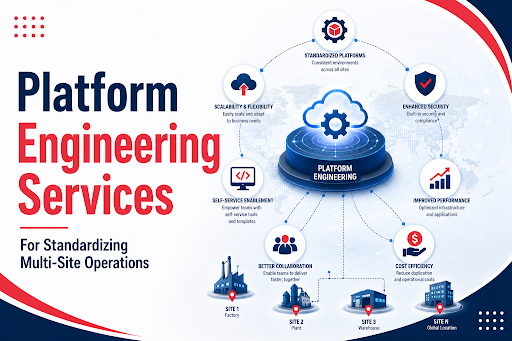
Operations management of multiple sites is getting increasingly complicated for companies nowadays. In the case of production lines, infrastructure, storage spaces, and any type of industrial facility, it becomes difficult for organizations to ensure uniformity at all sites without the proper mechanisms in place. This is where platform engineering services step into the picture. With the help of platform engineering, organizations can develop systems, standards, and operational processes that optimize performance in all locations.
Organizations that operate from more than one location may experience issues such as irregular processes, varying technology, communication difficulties, and varied standards for running operations. Such issues might affect efficiency, increase operational costs, and make sustainability unattainable. Through platform engineering, organizations receive a platform that is flexible yet systematic in its approach.
Why Standardization Matters Across Multiple Sites
For organizations that have grown from one location to many locations, operating using various systems in those places might work. However, it can also be counterproductive in the long run by leading to inefficient operations.
Benefits of standardization for businesses:
- Maintain consistent quality across all sites
- Improve visibility into operations
- Reduce downtime and errors
- Simplify staff training and onboarding
- Improve collaboration between teams
- Support faster decision-making
A standardized operational platform can also be used by management to monitor performance more effectively. With similar systems and reporting mechanisms at each location, problem identification and process improvement become much simpler.
The Role of Platform Engineering in Operations
Platform engineering is an approach to the design and implementation of centralized solutions that will ensure consistent operation. It combines engineering solutions, optimization of processes, and digitalization.
Some features of platform engineering can include:
Integrated Operational Systems
For most businesses, there are several software platforms for scheduling, reporting, maintenance, safety management, and communications. Platform engineering helps to implement an integrated system.
As a result, the business will be able to:
- Access to real-time data about operations
- Eliminate manual reporting of performance metrics
- Coordinate actions within departments
- Increase transparency across various locations
Scalable Infrastructure Design
With growth, enterprises should be capable of expanding their operations and frameworks. This is what platform engineering provides because it allows growing infrastructures without disrupting the whole process.
Scalability makes it possible to:
- Add new locations more efficiently
- Maintain operational consistency
- Reduce implementation delays
- Improve long-term cost management
Process Automation
Nowadays, automation becomes crucial when it comes to companies that deal with multi-location operations. Routine tasks take much time to complete and pose many risks of mistakes.
Platform engineering makes automation of such tasks possible. It helps to handle:
- Maintenance scheduling
- Equipment monitoring
- Workflow approvals
- Inventory tracking
- Reporting and compliance management
Thus, teams can concentrate on other operational tasks instead of completing routine actions.
Improving Collaboration Across Teams
The problem in multi-location operations is the lack of proper communication. There may be different reporting styles, procedures, and methods used at each particular location. Such an approach often results in misunderstandings and delays.
Using an engineering platform helps to achieve the collaboration that is needed for a business to succeed. Employees have the same access to operational data, project management, and maintenance records, no matter where they operate from.
It allows firms to:
- Increase their response speed
- Eliminate redundancies
- Maintain high levels of accountability
- Coordinate projects effectively
Moreover, effective collaboration promotes better decision-making processes on both operational and managerial levels.
Supporting Safety and Compliance Standards
Manufacturing, construction, utilities, and infrastructure industries have to comply with rigorous safety and compliance regulations. Maintaining compliance among multiple facilities can be difficult without standardized systems.
Platform engineering services prove to be extremely helpful when it comes to keeping everything under control.
Using engineering platforms will allow organizations to:
- Document all compliance activities
- Standardize all safety protocols
- Perform inspections and maintenance
- Keep all documents in one place
- Create compliance reports efficiently
Unified safety systems allow organizations to minimize their risk exposure while meeting operational standards.
Data-Driven Decision Making
Data generation has become a daily reality for modern-day operations. Yet, data becomes valuable only when organizations can efficiently sort and analyze it.
Platform engineering develops solutions to gather and consolidate operational data for all facilities. It enables organizations to detect patterns, track performance, and enhance operational strategies.
Examples of valuable findings include:
- Equipment performance trends
- Resource utilization rates
- Maintenance efficiency
- Production delays
- Energy consumption patterns
With greater data visibility, management will be able to make quicker and more insightful operational decisions.
Reducing Operational Downtime
Downtime can cause substantial negative effects on productivity and profitability. Multi-site operations are even more susceptible since any problem at one facility may have a wider operational impact.
Engineering platforms facilitate predictive maintenance and operational monitoring. Instead of dealing with emergencies once they arise, organizations can anticipate them beforehand.
Key advantages of such an approach include:
- Predictive maintenance scheduling
- Rapid fault detection
- Lower rates of equipment breakdowns
- Longer equipment life span
- Better resource distribution
It allows companies to keep their operations consistent throughout all sites.
Flexibility Without Losing Consistency
While standardizing doesn’t require that all facilities be identical, there can be different needs at each site when it comes to equipment, staffing, and processes.
An effective engineering system will enable organizations to maintain consistency while allowing them some flexibility at certain sites. Companies can uphold their standards but adjust where needed to increase efficiency.
The ability to do so is important for ensuring:
- Local operational efficiency
- Industry-specific requirements
- Regional compliance standards
- Scalable business growth
Organizations that can strike this balance are more likely to adapt quickly to future growth.
Building Long-Term Operational Stability
Expanding operations shouldn’t add more complexity. Firms that prioritize platform engineering from the start are more likely to succeed in the long run.
Engineering strategies can help firms:
- Simplify operations
- Increase operational resiliency
- Facilitate digital transformation
- Achieve higher levels of efficiency
- Build a scalable operation framework
As industries embrace intelligent technology and interconnectedness, companies that use a standard approach to running their operations will enjoy greater competitive strength.
Creating a Smarter Future for Multi-Site Operations
Companies that have multiple sites should not rely on ad-hoc solutions. Instead, they require systems that enable them to maintain consistency, scale, and optimize their operations in the long run. That’s why platform engineering services have become a critical component of current industrial operations.
For those firms that require improved operational efficiency through systems integration and process standardization among several locations, the services of an engineering expert would be highly beneficial. CSA Engineering provides engineering expertise and custom solutions that enable firms to improve their operations and foster sustainable development. The company’s experience in engineering design, operational systems, and project delivery makes it an ideal candidate for such endeavors.