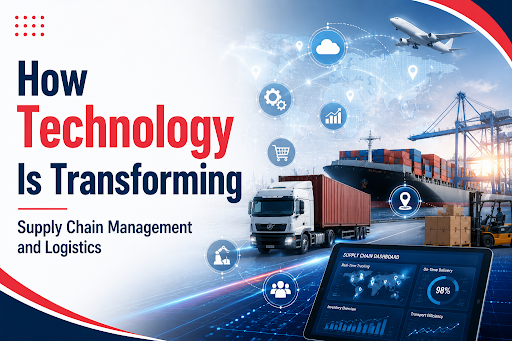
Organizations in today’s world work in a highly interconnected business environment where efficiency, speed, and precision have gained more significance. It is crucial for organizations, whether in manufacturing industries or retail industries, to achieve their objective without any delay by moving goods from one place to another. In such scenarios, modern technology has brought a revolution in the field of supply chain management and logistics by making use of modern technology in their business processes. This not only helps organizations in increasing their visibility but also helps them in lowering their costs and managing their inventory.
With the growth of global competition and shifting customer preferences, it has become impossible for firms to use inefficient and obsolete management practices. Such concepts as automation, data analysis, artificial intelligence, and smart tracking systems help organizations establish more reliable operations.
The Shift from Traditional to Smart Operations
Earlier, the operations of logistics were based on a high number of paper documents and manual controls. The above factors often resulted in errors, delivery delays, and inconsistencies in the inventory control process. Modern technological approaches have made great improvements in these spheres.
By utilizing cloud-based platforms and digital tracking services, it has become possible for businesses to monitor their assets in real-time. Management personnel will be able to receive instant information about deliveries, warehousing operations, and stock levels at all times.
Organizations such as CSA Engineering also point out the significance of process optimization in the area of modern engineering operations.
Real-Time Data Is Improving Decision-Making
One of the major benefits associated with digital transformation is the real-time access to data. Firms can monitor all operations during the process thanks to advanced software solutions and interconnected equipment.
The following list shows how the tracking system assists firms in performing operations:
- Detecting shipment delays immediately
- Optimizing the delivery schedule
- Cutting extra costs related to operations
- Monitoring the performance of the warehouse
- Improving customer communication
As such, the instant availability of information allows for resolving all potential issues before they escalate. The process of making forecasts and avoiding shortages also becomes much easier.
Automation Is Reducing Human Errors
Today, automation has become an integral part of many warehouses and distribution centers around the world. Some operations that required several hours of work can be performed instantly thanks to advanced solutions and robotics.
Here are some examples of such processes:
- Automated inventory management
- Using barcodes and RFIDs
- Robotized picking solutions
- Automated sorting and packing
- Optimized transportation scheduling
They enhance efficiency and minimize the chances of errors. In addition, they assist companies in saving time and cutting labor costs without having any negative effects on product quality.
Artificial Intelligence Is Making Logistics Smarter
The application of Artificial Intelligence (AI) in contemporary enterprises is growing significantly. The technology analyzes large volumes of information to find correlations between different aspects and make predictions.
As an aspect that falls within supply chain management and logistics, AI makes companies capable of predicting demand, optimizing routes, and even minimizing fuel consumption through its analytics capabilities.
In addition, the technology enhances risk management in organizations because it enables them to detect possible problems that arise from various issues like weather conditions, supplier problems, or delivery problems.
The Role of IoT in Modern Logistics
The emergence of the Internet of Things (IoT) has made contemporary logistics operations highly connected. For instance, smart sensors provide continuous monitoring and sharing of information related to logistics processes.
Some examples include:
- Temperature sensors check sensitive items during transportation.
- GPS devices check the positions of vehicles on the move.
- Sensors keep track of warehouse environments.
- Devices make fleet management easy.
Such technologies are useful especially in sectors handling perishable food items, pharmaceuticals, and other delicate goods, where environmental concerns are a priority.
Digital Warehousing Is Increasing Efficiency
Warehouses have evolved from basic storage facilities to smart operation centers driven by modern technologies.
Several benefits can be gained through the use of modern warehouse management systems, such as:
- Proper organization of goods
- Reduced storage losses
- Higher accuracy of orders processing
- Improved dispatch process efficiency
- Immediate monitoring of stocks
In many warehouses, products are delivered with the help of automated guided vehicles and robots. In this way, efficiency and speed are increased while avoiding potential risks.
Blockchain Is Enhancing Transparency
The use of blockchain in logistics has become popular in recent years due to its ability to create safe and transparent records of transactions. Each transaction and delivery update is logged on a distributed digital ledger and cannot be easily modified.
The adoption of blockchain technology allows companies to:
- Boost shipment traceability
- Reduce potential for fraud
- Promote transparency throughout supply chains
- Create trust among suppliers and customers
Blockchain is especially useful in sectors where there is a need for authenticity and compliance.
Better Customer Experiences Through Technology
Today, consumers demand timely delivery and proper updates. Technology has been used by firms to address these issues in a better way.
The following features have played a crucial role in enhancing customer satisfaction:
- Real-time tracking of shipments
- Automatic delivery alerts
- Efficient order handling process
- Superior communication channels
Companies that utilise innovative technology can provide seamless and efficient services, thus building stronger customer relations and creating a good reputation.
Sustainability Is Becoming a Priority
Technology can also be used to ensure sustainability within a company’s operations. Smart logistics can assist in cutting down fuel usage, effective route management, and decreasing wastage.
Environmental changes include:
- Use of electric delivery vans
- Energy-efficient storage facilities
- Route optimization software
- Documenting processes digitally to reduce paperwork
Sustainability is not only an environmental issue anymore. It is now a vital approach used by businesses as a part of their strategic planning in order to ensure future operational efficiency and cost reduction.
Building Smarter Operations for the Future
Future trends in logistics and engineering will be focused on innovations in the fields of automation, smart technologies, and engineering solutions. Those companies that are able to adapt to changes in advance have better chances to remain efficient in the future.
As industries move ahead with modernizing themselves, there is no doubt that one area that shall need constant innovation in order to be successful is supply chain management and logistics. Businesses that seek reliable engineering services can contact CSA Engineering to fulfill all their modern requirements regarding operations and engineering.