In today’s world, building and manufacturing processes encompass much more than technical plans and construction timetables. It takes proper planning, technical know-how, and sound decision-making throughout the entire process to make sure that everything goes as smoothly as possible. This is where engineering consultant services come into great use. They assist companies in making projects work by reducing risks and increasing efficiency.
Regardless of whether you are implementing a manufacturing plant, energy facility, transport network, or any other industrial project, consulting engineers will give you a technical vision and help you achieve desirable results.
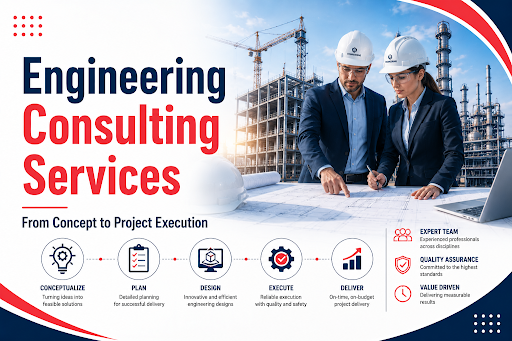
The Early Planning Stage Shapes Everything
Engineering projects begin with ideas, but the development of those ideas into solutions needs thorough analysis. While planning is going on, consultants check for technical feasibility, budget concerns, environmental considerations, timeframes, and regulations.
The planning phase involves the following activities:
- Conducting site investigations and technical analyses
- Performing preliminary engineering investigations
- Estimating costs and preparing budgets
- Performing risk assessments and mitigation plans
- Reviewing regulatory aspects and compliance requirements
- Assessing resource availability and infrastructure
Such early identification of problems helps businesses avoid making costly modifications to their designs or facing delays in their projects in the future.
A well-planned engineering project leads to better cooperation between all stakeholders, contractors, engineers, and project managers, thus avoiding misunderstandings during the implementation of the project.
Turning Concepts into Detailed Designs
After completing the planning process, it is time for the next step involving engineering design and development. This stage requires close cooperation with clients to translate their concepts and requirements into detailed engineering designs.
The creation of detailed designs may involve the preparation of structures, machinery, electrical installations, and optimization processes. Accuracy at this stage of project development is crucial since design flaws may have a serious impact on the final results of the project and its maintenance expenses.
Moreover, engineering consultants make sure that the design of the projects complies with:
- Industry standards and regulations
- Environmental standards
- Requirements for safety in workplaces
- Sustainability initiatives
- Operational efficiency standards
The design process that involves clients will allow for minimizing the risks of potential problems in the future.
Managing Technical Challenges During Execution
During the construction and implementation stages of such projects, unforeseen technical problems usually come up. For instance, material supply delays, design clashes, unfavorable weather conditions, and operational changes may affect schedule and budget planning.
An experienced consultant provides constant technical assistance in overcoming these difficulties. Engineering consulting services is one of these areas where this kind of service becomes indispensable because it plays a significant part in translating the intentions of an engineer into reality.
In most cases, consultants will work with the contractor, supplier, and the manager responsible for the construction process to ensure that their work adheres to the engineering design.
The following list outlines some of the critical responsibilities of the engineering consultant during project execution:
Technical Coordination
Consultants interact with many parties to ensure that engineering specifications are strictly followed.
Quality Assurance
Inspecting and conducting technical reviews can help uphold engineering standards and eliminate rework expenses.
Project Monitoring
Engineering consultants monitor progress, identify any potential delays, and make recommendations when required.
Cost and Risk Control
Continuously monitoring costs and operational risks can be instrumental in saving money and preventing risks from escalating.
Apart from being technical roles, their involvement in the project delivery process ensures that businesses exercise control over the projects during execution.
Supporting Sustainability and Long-Term Performance
With modern engineering project implementation, there is a greater emphasis on sustainability, energy efficiency, and performance. Engineering consultants assist companies in achieving both higher levels of sustainability and reduced operational costs within environmental regulations.
This can be achieved through an evaluation of:
- Energy-efficient technology
- Waste and water management systems
- Sustainable construction techniques
- Carbon reduction techniques
- Lifecycle performance of assets
Taking into consideration the performance of systems during design and execution phases reduces maintenance costs and increases reliability.
Moreover, this type of planning allows companies to remain competitive in industries where environmental performance and operational efficiency are critical for business success.
Why Industry Experience Matters
Every engineering project is not executed using the same strategy or plan. Every industry requires different technologies, regulations, and operational requirements. That is why industry expertise is important when it comes to successful project delivery.
Industry experience means that consultants are familiar with challenges associated with industries such as:
- Mining and resources
- Manufacturing and industrial processing
- Infrastructure and transport
- Energy and utilities
- Water treatment and environmental systems
Technical expertise that allows applying it to real-world scenarios contributes to making sound business decisions while executing projects at various stages.
Communication skills are just as critical for engineers. Consultants need to convey the technical aspects clearly to ensure that all parties participating in the project understand the goals and risks associated with it.
The Value of Integrated Project Support
One of the most significant advantages of using engineering consultants is the ability to receive integrated support for all project phases. Unlike having several teams responsible for planning, design, compliance, and execution of work, integrated consulting support provides an opportunity to coordinate project activities.
Integrated consulting services may improve:
- Project efficiency
- Budget management
- Communication between teams
- Regulatory compliance
- Operational reliability
- Overall project quality
Projects that involve numerous disciplines and stakeholders would significantly benefit from this approach.
A structured engineering process makes it possible to respond to any changes to project requirements during planning or execution.
Building Confidence Through Smart Engineering Decisions
Engineering projects involve much more than just knowledge of technical expertise. It requires proper planning, solving problems, managing risks, and coordinating effectively throughout the entire project development process. Projects that receive adequate professional consultation tend to perform better due to safety, efficiency, and cost-effectiveness in their operation.
With the ever-changing nature of industries, there is an increasing need for professional engineering consultancy services that are reliable and geared toward the future. For companies in search of effective technical and project consultancy services, CSA Engineering offers practical engineering consultancy that suits industrial and infrastructural needs. Apart from effective consultancy on project development, modern companies also require consultancy services for industrial engineering, infrastructural project management, engineering design consultants, process engineering, and technical project consultancy to improve long-term operational success.