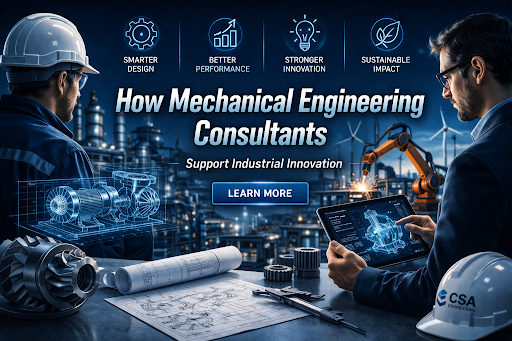
Industrial innovation is not a process that takes place by accident but is instead a process that involves planning and expertise, and where businesses and industrial experts come together in a collaborative effort. The mechanical engineering consultant is a very integral part of this process, and their role in this process is to help industries innovate by designing better systems and ideas in a practical and efficient manner.
From manufacturing plants to product development companies, engineering consultants have been and are being used by organizations to help turn their technical challenges into practical solutions.
Turning Concepts into Practical Engineering Solutions
Another important service offered by engineering consultants is assisting businesses in implementing concepts into functional systems or products. The teams in the industry may have strong concepts, but may need the expertise of engineering consultants to develop them further.
The role of engineering consultants in this process is as follows:
- Assessing initial design concepts and suggesting areas for improvement
- Carrying out flexible studies to determine whether a design can be manufactured successfully
- Offering technical models and simulations to determine their functionality
- Ensuring that designs meet engineering standards and industry regulations
Engineering consultants act as a link between concept development and implementation, allowing businesses to proceed with confidence and avoid costly design mistakes.
The Role of Early Design Collaboration
Collaborations between engineering consultants and project teams in the early stages can result in stronger and more innovative designs. If engineering consultants are involved during the early stages of project planning, they can analyze the weaknesses of the designs and provide suggestions for alternative mechanical systems and materials.
This approach will not only minimize redesigns in the project but also ensure that innovation is incorporated into the project through engineering decisions from the start. A mechanical engineering consultant can also assist project teams in determining the best manufacturing processes and mechanical designs for projects to move ahead with clarity and efficiency.
Supporting Efficiency and System Performance
Industrial innovation is not just about creating new products. Organizations often attempt to optimize their current equipment, processes, and mechanical systems.
In some instances, a mechanical engineering consultant may work in close collaboration with the operations team to identify areas of inefficiency and provide suggestions for improvement. This may include the analysis of machinery efficiency, material flow, or designing mechanical parts to make them more durable.
Some benefits of improving efficiency include:
- Less energy consumption
- Longer equipment lifespan
- More efficient production
- Lower maintenance costs
By concentrating on reliability and optimization, consultants can make sure that businesses remain competitive in sectors that are constantly and rapidly changing.
Collaboration Across Multiple Engineering Disciplines
Contemporary industrial projects tend to involve sophisticated systems that integrate mechanical, electrical, and structural aspects. Consultants commonly work with engineers from other fields to ensure that all aspects of a project work well together.
Such collaboration is particularly important during the execution of large-scale infrastructure or manufacturing projects, where mechanical systems need to work in conjunction with automated systems, digital monitoring systems, and structural systems.
By working together, consultants help ensure that innovations are both technically feasible and implementable.
Managing Risk Through Technical Expertise
Uncertainty is always present in innovation. New ideas or production methods may pose certain risks if they are not assessed carefully.
Engineering consultants can reduce these risks by carefully assessing and testing them. Their tasks may include:
- Reviewing mechanical designs for safety and reliability
- Performing technical calculations and stress analysis
- Evaluating environmental and operational factors
- Analyzing possible failure points from the early stages of development
Such an evaluation may also be useful in helping businesses avoid delays and ensure that the new technology works at optimum levels when implemented.
Engineering Expertise That Drives Future-Ready Industries
As new technologies and technologies related to advanced manufacturing continue to be incorporated into this industry, the importance of the mechanical engineering consultant will only continue to grow. An experienced consultant can offer strategic guidance that fuels innovation in areas like industrial design engineering, product development engineering, CAD design services, finite element analysis, and manufacturing process optimization.
Through their expertise and knowledge, companies such as CSA Engineering have a significant role to play in the creation of future-ready mechanical systems that may be able to sustain this industry.