Introduction
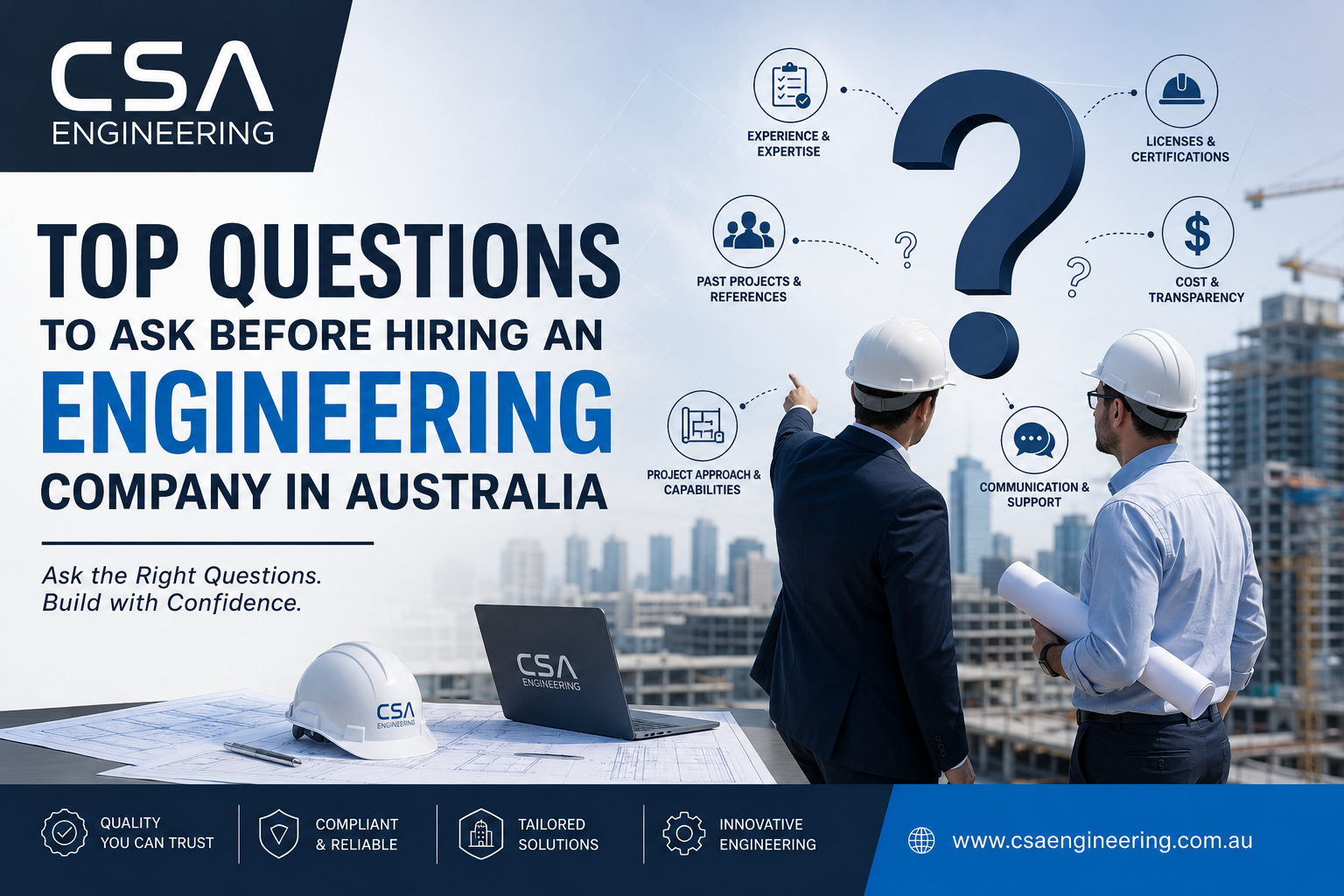
Selecting an engineering company in Australia is one of the most consequential decisions a business can make. Whether you are commissioning a new industrial facility, seeking certification for pressure equipment, or developing a structural building project, the firm you choose will directly determine the quality, legality, and long-term performance of the outcome. A poorly selected partner can deliver documentation that fails regulatory scrutiny, certifications that collapse under legal challenge, and engineering advice that costs far more to fix than it saved to obtain. The right engineering partner, by contrast, becomes a strategic asset that protects your investment, accelerates your approvals, and keeps your project on the right side of every applicable Australian standard. Knowing which questions to ask before you engage is the single most effective way to make that distinction before it matters.
CSA Engineering has supported businesses across Australia through complex engineering, compliance, and certification projects. This guide draws on that experience to give you the questions that genuinely differentiate capable engineering firms from those that simply look the part.
Question 1: What Industry Experience Does the Engineering Company Have?
Experience in engineering is not generic. An engineering firm that excels at residential building design may have no practical knowledge of industrial pressure systems, lifting device certification, or trailer compliance. Before engaging any firm, ask specifically about their experience in your industry sector and with your equipment or project type. Request examples of similar projects, ask about the outcomes, and find out whether the same engineers who worked on those projects will be working on yours. Broad claims about years of operation mean little without specific, verifiable project references. Accessing the right Engineering Services for your sector is the foundation of a successful project outcome.
Question 2: Do They Offer Comprehensive Engineering Consulting Services?
Many businesses engage an engineering firm expecting end-to-end project support, only to discover that the firm handles design but not certification, or certification but not inspection. This fragmentation creates coordination problems, documentation inconsistencies, and approval delays. Ask your prospective provider whether their Engineering Consulting Services cover the full scope of your project from initial feasibility through design, compliance review, certification, and ongoing support. A firm that can manage the entire lifecycle under one roof eliminates the handover risks that fragment responsibility and complicate the approval process.
The most valuable engineering partners offer more than technical services. They provide strategic guidance that helps clients anticipate regulatory changes, plan asset lifecycles, and make informed investment decisions. This broader advisory function is the hallmark of a genuine Engineering Consultant relationship rather than a transactional vendor arrangement.
Question 3: Are Their Engineers Properly Certified and Qualified?
In Australia, the legal standing of an engineering sign-off depends entirely on the qualifications and registration of the engineer providing it. Ask prospective firms for the specific qualifications held by the engineers who will work on your project. Confirm that those qualifications are recognised under Australian law and are appropriate for the type of engineering work involved. Professional Engineer Certification carries formal professional accountability, meaning the engineer is legally and professionally responsible for the accuracy of every certificate they sign. This accountability is what gives the certification its regulatory weight and legal validity.
- Confirm the specific engineer assigned to your project holds current professional registration
- Verify that their discipline aligns with your project type, whether structural, mechanical, or industrial
- Check that their qualifications are recognised under state and national Australian legislation
- Ask whether they carry professional indemnity insurance appropriate to the scope and value of your project
Question 4: Can They Assist With Engineering Certification Requirements?
Certification is often the most critical and least understood aspect of engineering project delivery. Ask your prospective engineering partner to explain exactly what Engineering Certification they provide, what standards the certification covers, and how it interfaces with the relevant regulatory authority. A firm that cannot clearly explain the certification process for your project type is unlikely to navigate it effectively on your behalf. Ask for examples of certified projects that have successfully passed regulatory review and speak to references who can confirm the certification held up under scrutiny.
- Ask which Australian Standards and regulatory frameworks apply to your project
- Confirm that certification documentation will be signed by a registered engineer, not a technician
- Verify that the firm understands the submission requirements of the relevant certifier or authority
- Request a sample certificate or documentation package from a similar completed project
Question 5: Do They Have Industrial and Mechanical Engineering Expertise?
Industrial and mechanical projects present engineering challenges that require specialist expertise. Pressure vessels, conveyor systems, lifting platforms, and process plant all involve complex load paths, material requirements, and regulatory obligations that go beyond standard structural analysis. An experienced Industrial Engineering Consultant understands how industrial systems behave under real operating conditions and how to design and certify them to meet both Australian Standards and practical performance requirements.
For machinery, mechanical systems, and equipment certification, the depth of a firm’s mechanical engineering expertise is equally critical. A qualified Mechanical Engineering Consultant brings materials knowledge, fatigue analysis capability, and hands-on understanding of how mechanical systems degrade over time under operating loads. Ask prospective firms specifically about their mechanical engineering team, their software tools, and their experience with the type of equipment involved in your project.
Question 6: How Do They Approach Compliance, Safety, and Risk Management?
A rigorous approach to compliance and risk management is the distinguishing characteristic of engineering firms that protect their clients from legal and financial exposure. Ask how the firm identifies compliance obligations at the outset of a project, how they manage changes to regulatory requirements during the project lifecycle, and how they respond when a compliance issue is identified during the assessment process. The answers will reveal whether the firm treats compliance as a core engineering function or as an administrative afterthought.
- Ask how they stay current with changes to Australian Standards and state-based regulations
- Confirm that they conduct formal risk assessments as part of the engineering process
- Ask how they manage documentation to ensure consistency across the full project package
- Verify that their process includes formal peer review of engineering outputs before certification
Question 7: Can They Provide End-to-End Engineering Services?
End-to-end capability means the ability to take a project from initial concept through design, analysis, documentation, certification, and post-approval support without handing off responsibility to another party at a critical stage. Ask your prospective firm to walk you through their complete project delivery process and identify where, if anywhere, external parties are involved. The best providers of Engineering Services maintain complete control over every phase of the engineering process, ensuring that documentation is consistent, responsibilities are clear, and the client has a single accountable point of contact throughout.
Question 8: Do They Employ an RPEQ Engineer for Queensland Projects?
For projects in Queensland, this question is non-negotiable. Queensland’s Professional Engineers Act 2002 requires that engineering services above defined thresholds be provided by a Registered Professional Engineer of Queensland. Engaging a firm that does not employ a qualified RPEQ Engineer for Queensland work means that the engineering sign-off may not be legally accepted by Queensland building certifiers, regulatory bodies, or government procurement processes, regardless of the technical quality of the underlying work.
CSA Engineering employs RPEQ-registered engineers across its service lines and has a dedicated office in Stapylton, Queensland. This means that clients with Queensland projects receive RPEQ Certification that satisfies the full requirements of Queensland legislation without the risk of documentation rejection or compliance gaps. For businesses operating across multiple Australian states, working with a firm that holds both RPEQ registration and relevant credentials in other jurisdictions provides the broadest and most defensible compliance coverage available.
Question 9: What Is Their Process for Quality Assurance and Project Delivery?
A well-structured quality assurance process is the internal mechanism through which engineering firms ensure that their outputs meet the required standard before they reach the client. Ask prospective firms to describe their QA process in specific terms. Who reviews the engineering calculations before they are finalised? How are design changes managed and communicated? What checks are in place to catch errors before documentation is submitted for certification? These questions reveal the operational maturity of the firm and its commitment to delivering outputs that are accurate, complete, and defensible. The most capable RPEQ Engineers Australia operate within formal quality management systems that provide clients with genuine assurance rather than verbal promises.
Question 10: Can They Support Future Engineering and Certification Needs?
Engineering requirements do not end at project completion. Equipment must be recertified as standards evolve. Facilities require periodic inspection and fitness-for-service assessment. Structures need engineering review when they are modified or repurposed. Asking a prospective firm about their capacity for ongoing support reveals whether they are capable of being a long-term technical partner or simply a transactional service provider. The best Engineering Consulting Services relationships are built on the kind of accumulated project knowledge that only comes from sustained engagement over time.
Why Businesses Across Australia Choose CSA Engineering
CSA Engineering has established itself as a trusted engineering and certification partner for businesses across Australia’s most demanding industries. The firm’s team includes registered engineers across structural, mechanical, industrial, and trailer disciplines, with RPEQ registration for Queensland projects and credentials recognised under national and state legislation. CSA Engineering’s approach combines technical rigour with practical project management, delivering outcomes that satisfy regulators, certifiers, insurers, and clients alike.
Clients who partner with CSA Engineering benefit from:
- End-to-end engineering and certification support with a single accountable point of contact
- RPEQ-registered engineers for Queensland compliance and appropriately registered professionals for other Australian states
- Integrated services spanning structural, mechanical, industrial, trailer, and building engineering disciplines
- Certification documentation accepted by Australian building certifiers, regulatory bodies, and government authorities
- Ongoing compliance support that keeps clients ahead of regulatory changes and recertification obligations
To discuss your project requirements with the CSA Engineering team, visit our engineers directly.
Conclusion
Hiring the wrong engineering company in Australia is an expensive mistake that can take years and significant resources to correct. The questions outlined in this guide give you the framework to evaluate prospective partners based on substance rather than presentation. Qualifications, registration, industry experience, certification capability, quality assurance processes, and ongoing support capacity are the factors that genuinely determine whether an engineering partner will protect your project or put it at risk.
CSA Engineering welcomes these questions because the answers demonstrate exactly why so many Australian businesses, from manufacturers and mining operators to builders and industrial facility managers, trust CSA Engineering as their long-term engineering partner.